Will society accept me as a designer (vibe-coded) if I don't have a vibe-coded component library?
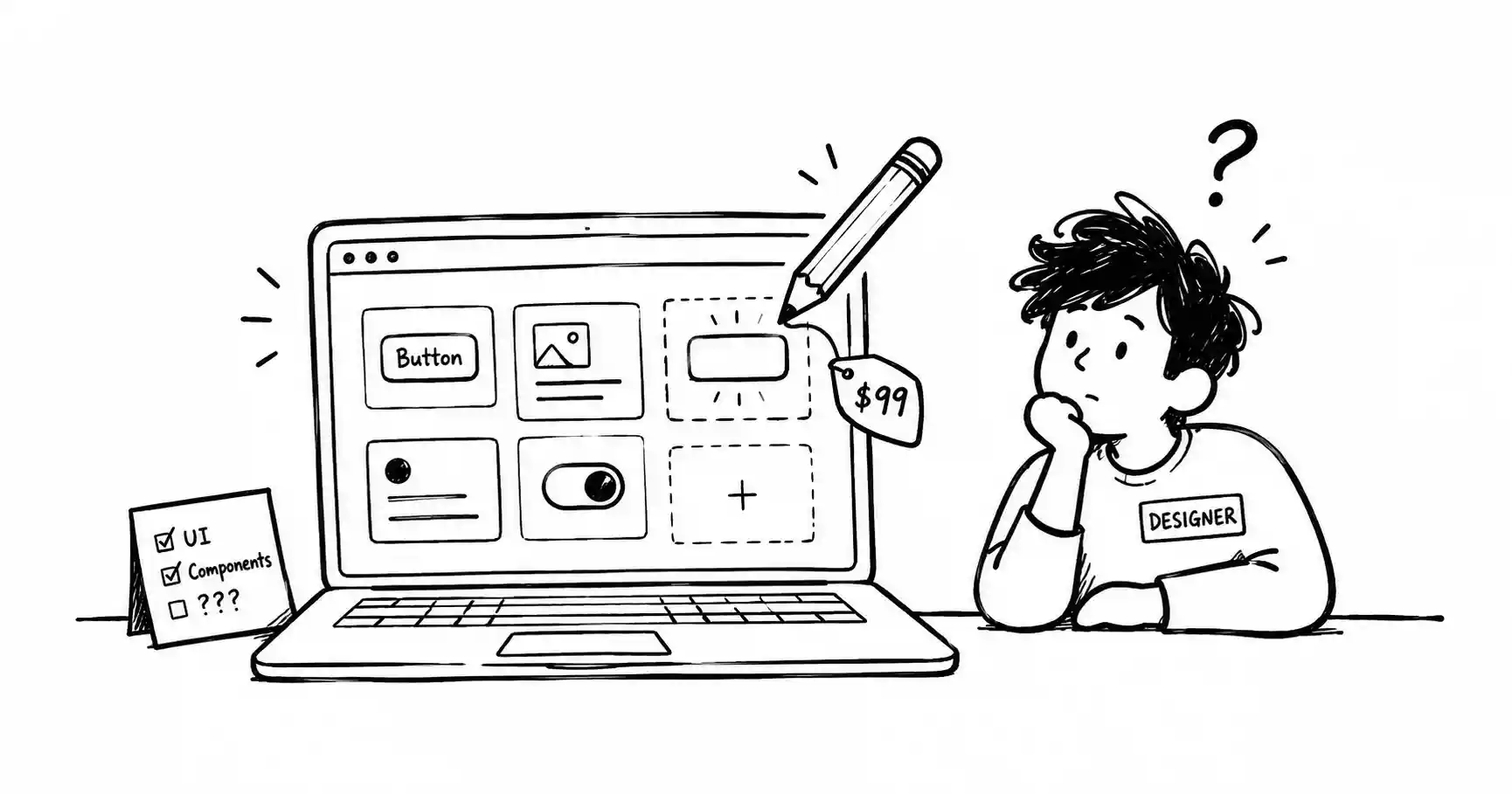
Something strange has been happening on my timeline for the last few months. People who were shipping "I built a SaaS in a weekend" tweets six months ago are now calling themselves product designers. Not developers who use AI. Not indie hackers. Designers.
And if you look at what they're actually shipping, it's always one of two palettes. Either it's #000000, #181818, #ffffff, #efefef — the "minimal dark" starter pack — or the exact same thing in reverse. That's it. That's the whole design language for an entire generation of self-declared designers right now. Two themes, infinite founders.
I don't think this is a coincidence, and I don't think it's really about design at all.
The question I actually keep asking myself
I don't have a component library. I never forked shadcn, never reskinned it, never put a price tag on a weekend of border-radius tweaks. And somewhere in the back of my head there's this nagging thing: does that mean I don't count? Is that the entry ticket now? Do I need a $99 "kit" with my name on it before anyone on X treats me like a real vibe-coded designer?
I don't think it should be. But I also can't pretend the pressure isn't real, because right now that is the signal everyone's reading. No kit, no credibility. Ship a library, get the badge. It's starting to feel less like "did you design something good" and more like "did you produce the artifact that proves you're in the club."
That's the actual anxiety underneath this whole post. Not "is this trend annoying" — it clearly is — but "am I going to be judged by a checklist that has nothing to do with whether I can actually design."
The pipeline is always the same
Here's the pattern, and if you've spent any time on X in a niche like this, you've seen it too:
- Someone vibe codes an app. Gets a bit of traction, a few thousand impressions, maybe a viral screenshot.
- Somewhere in that process they start posting "day in the life of a solo founder" or "building in public" content, and at some point the word designer quietly enters their bio.
- Once they've got some reach, they go looking for a component library — usually something already open source, already live, already used by thousands of people.
shadcn/uiis the obvious one, but there's a whole ecosystem of these now. - They fork it. They change the border radius. They swap the accent color. They rename it to something with "kit" or "UI" in the title.
- They put a $99–$150 price tag on it and sell it as their own design system.
None of this is illegal, and I'm not accusing anyone of literal theft — most of these are MIT licensed, forking is allowed, that's the whole point of open source. What gets me is the framing. It gets sold as "I built a component library," past tense, finished, proud, like it's an act of design authorship. Two days of prompting a coding model to change some CSS variables becomes a personal brand pillar.
The part that actually bothers me
Here's what I keep coming back to. Somewhere, right now, there's a design systems team at an actual company — a team of people with years of experience — who have spent months getting one component right. Not "it looks fine," but genuinely right: accessible, consistent across a hundred edge cases, tested against real users, documented so the next fifty engineers who touch it don't break it.
And then someone ships a re-skinned fork of an existing library in 48 hours and treats it like they just did the same job, just faster, because they had AI and the other team apparently didn't.
So which is it? Were those teams just not good enough? Were they slow, overpaid, overthinking it? Or is it that Claude, Codex, whatever model of the week, is just that well trained, that it can compress months of design iteration into a weekend?
I don't buy either explanation. What I think is actually happening is a lot simpler and a lot less flattering: changing a border-radius token and a background color is not the hard part of a component library. It never was. The hard part is everything invisible — state management, accessibility, composability, how a button behaves when it's inside a modal inside a drawer on a phone with a screen reader on. AI models are extremely good at the visible 10%. They are not doing the other 90%, and the people selling these kits mostly aren't either, because they don't know it exists yet.
What this is actually about
This isn't really a design movement. It's a personal branding move wearing a design costume.
"Designer" carries weight. It signals taste, judgment, years of caring about details nobody else notices. "I vibe coded an app" signals something else — speed, hustle, maybe luck. Calling yourself a designer after prompting a model to restyle an open source repo borrows credibility it hasn't earned yet. And because the aesthetic is so narrow — those same four hex codes, that same "confidently minimal" look — it's easy to pattern-match into "clean, considered, professional" even when nothing about the process was actually considered.
The pricing gives it away too. $100+ for something built in two days isn't priced like a product. It's priced like a badge. The buyer isn't really buying a component library — plenty of better ones are free. They're buying proximity to whoever built it, and the promise that they too can ship something that looks like a real design system by the weekend.
Where this leaves the actual conversation
None of this means AI-assisted design work is fake, or that everyone doing it is grifting. Plenty of people are using these tools honestly, learning fast, and getting genuinely better at design because the feedback loop is so much shorter now. That's a real and good thing.
But there's a difference between "AI let me learn design faster" and "I forked an existing library, changed two CSS variables, and now I'm a designer selling design systems." One is a skill. The other is a costume with a price tag on it.
The models aren't the problem. The problem is what people are choosing to call the output.
So to answer my own question: no, I don't think society — or this industry, or whatever we're calling the timeline — should require a reskinned component library before it accepts someone as a designer. If that's the bar, the bar is broken. I'd rather be the person without the kit than the person who thinks changing four hex codes over a weekend earned the title.